The Automation Trap: Why Friction Can Be Your Best Feature
Stop automating the drudgery and start automating the risk management. This post details how to use automation strategically, ensuring your scripts buy back human time for high-value work, instead of creating unmaintainable technical debt.
Build Founder Team
Copy link
The prevailing wisdom in modern engineering is simple: automate everything. If a task is repeatable, predictable, and doesn't require complex human judgment, hand it over to the machines. Yet, a blind, relentless pursuit of zero-friction automation can introduce more liability, complexity, and fragility than the manual process it replaced.
We must stop viewing automation as the universal goal and start treating it as a strategic decision that requires careful trade-offs.
The Three Costs of Automation
Before you write the next cron job or implement a complex CI/CD pipeline step, consider the three hidden costs that can quickly turn an efficiency gain into technical debt:
The Cost of Opacity (The Black Box Problem)
When a human performs a manual task—say, a complex database migration—they build intuition, spot anomalies, and can instantly intervene if something goes wrong.
The Automation Effect: Once automated, that task becomes a "black box." When the process eventually fails (and it will), the debugging time, or Time To Remediation (TTR), often explodes. The engineer must now debug not only the original task but also the automation script, the logging system, and the state management around the workflow.
The Guardrail: Implement observability first. Never automate a process without simultaneously implementing the monitoring, alerting, and logging required to understand exactly what the machine is doing at every step.
The Cost of Maintenance (The Script Farm)
Automation scripts are code. And as any senior engineer knows, code is a liability, not an asset.
The Automation Effect: Every script, every Terraform module, and every Jenkins pipeline is a dependency that must be versioned, tested and maintained. The combined maintenance burden of a vast "script farm" can quickly outweigh the marginal efficiency gains of automating a low-frequency task. You trade two hours of monthly manual labor for five hours of monthly maintenance liability.
The Guardrail: Automate high-frequency, high-value tasks only. If a task is run less than once a quarter, or if the time saved is less than the time required to build and maintain the script, it's often a net loss.
The Cost of Cognitive Detachment (The "Human-Detached" System)
The most dangerous cost is the degradation of human expertise.
The Automation Effect: When engineers never have to touch the lower-level processes, their deep knowledge of the system degrades. When the system catastrophically fails outside the automated happy path, the team is left with zero institutional memory or necessary manual skills to restore service. This is the core reason incident response teams often struggle with novel failures.
The Guardrail: Introduce intentional friction or "speed bumps." Critical processes—like deployments to production or changes to core infrastructure—should require a manual review step, a "break glass" approval, or even a periodic forced manual execution to ensure knowledge transfer and maintain familiarity.
The Strategy: Friction as a Feature
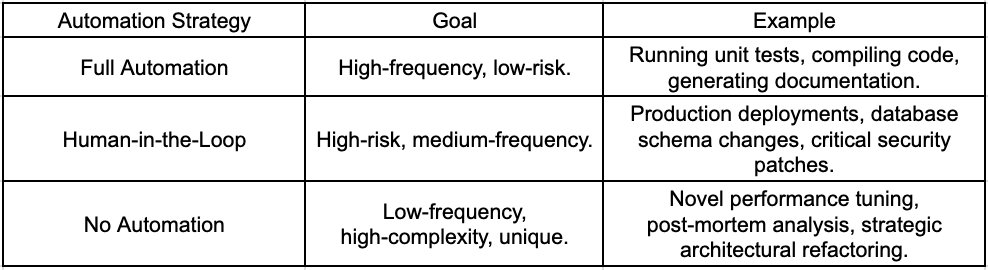
Instead of aiming for 100% automation, aim for strategic automation that buys back human time for higher-value work. A truly great system uses automation to handle the drudgery while using human-in-the-loop controls to manage the risk.
Choosing the right processes to automate is key
Don't automate the difficult decisions; automate the repeatable steps around the difficult decisions. Use automation to deliver the necessary data, run the necessary checks, and prepare the environment, but leave the final, high-stakes decision to the person with the most clarity of thought.
A truly great infrastructure moves beyond blind, 100% automation. It is a system where teams understand the strategic trade-offs, using automation to reduce drudgery while introducing friction (Human-in-the-Loop) to manage risk. This measured approach leads directly to reduced incident severity and resilient code. We specialize in applying the right architectural tools to the right job, ensuring your automation strategy becomes a high-velocity asset, not a source of maintenance liability. Just reach out today. We're ready to be your development partner as you scale.
Share this post
Copy link
What we’re learning, building, and thinking about
Check out our blogs for real stories, practical tips, and ideas to help you ship better software.